Pro Tips
Artificial Intelligence
Updates
AI Agents
CoralOS Financial Advisory System: Business Impact Assessment
Executive Summary
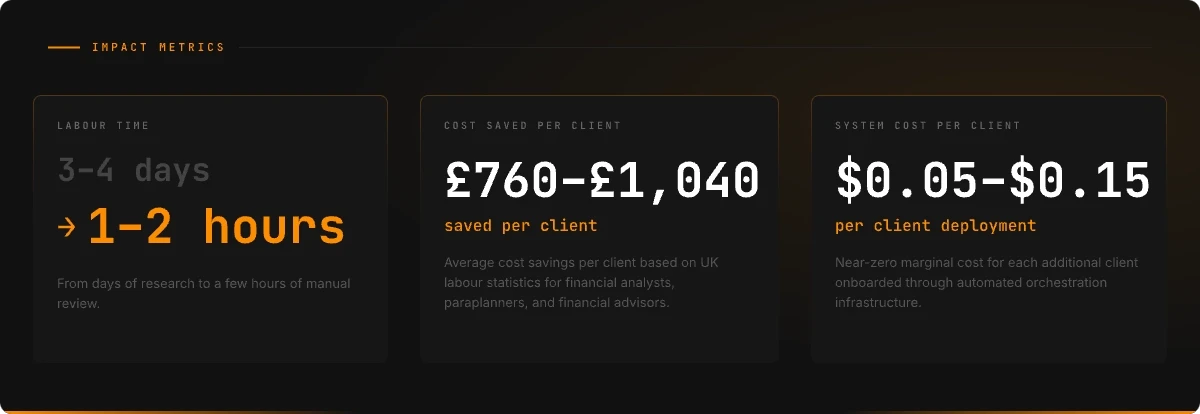
Financial advisory firms spend 3-4 working days per client on research, onboarding, and suitability report generation, costing £830-£1,110 in analyst time alone. CoralOS reduces this to 1-2 hours of human review, delivering net savings of £760-£1,040 per client. At scale, a firm onboarding 250 clients annually saves £190k-£260k in labour costs before accounting for faster time-to-recommendation, improved conversion rates, and reduced compliance risk.
The system's own operating cost is negligible. All 11 agents share a unified token-based pricing model at $0.000001 per token, with a typical end-to-end client workflow consuming 50,000-150,000 tokens (estimated based on agent token limits and typical workflow complexity), equating to $0.05-$0.15 per client. Against £830-£1,110 in displaced manual effort, the system cost is effectively a rounding error.
System Architecture Overview
Multi-Agent Design
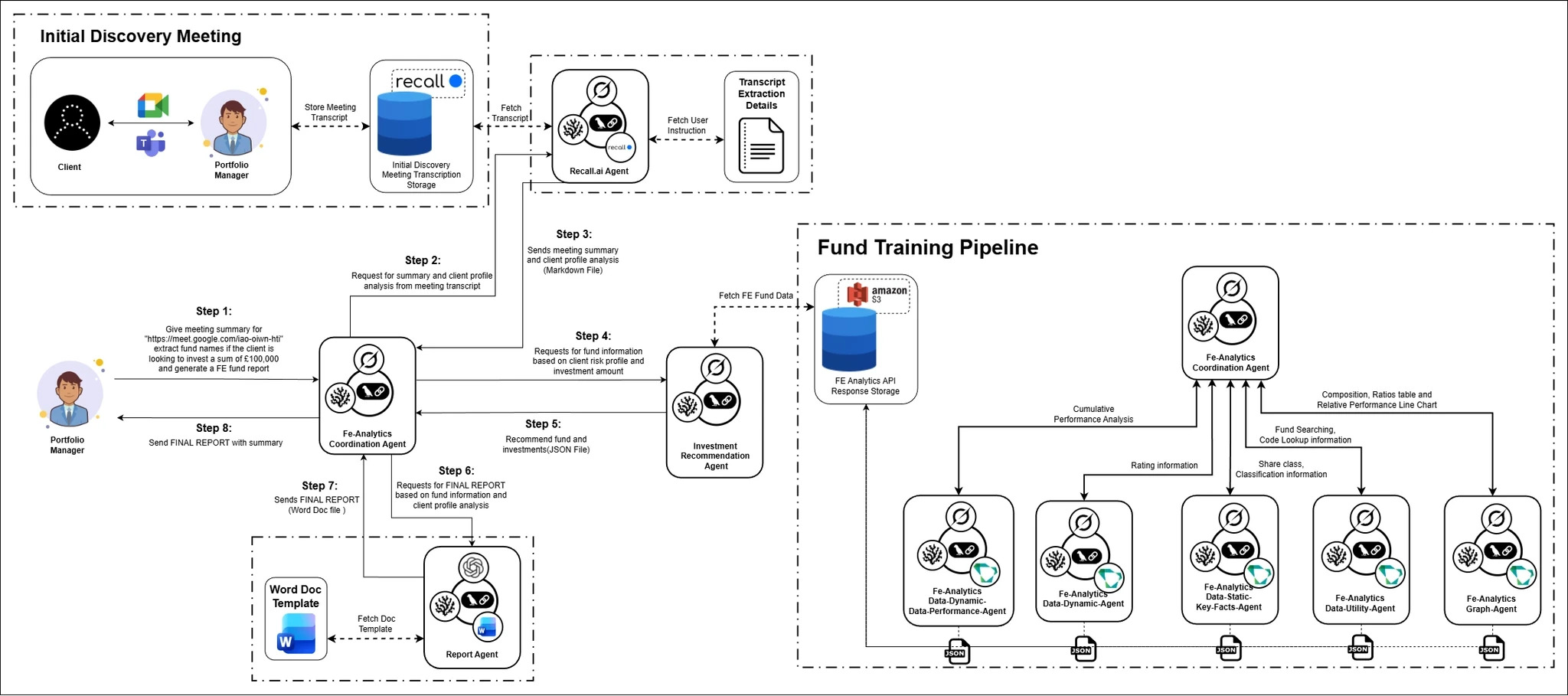
CoralOS is built on a decomposed agent architecture where 11 specialised agents each handle a discrete stage of the advisory workflow, coordinated through Coral Protocol. Rather than a single monolithic AI, the system deploys narrow experts that communicate peer-to-peer through a shared messaging layer.
The architecture breaks into four functional tiers:
Client Data Ingestion
The Recall Meeting Agent connects to meeting recording services (Zoom, Teams, Google Meet, Webex, Slack, and in-person meetings) via Recall.ai. It downloads full transcripts with speaker identification and timestamps, then uses an LLM to extract structured client profiles covering personal information, financial strategy, risk tolerance, income, expenditure, and net worth. What previously required 30-60 minutes of manual transcription and data entry is completed automatically with configurable extraction schemas.
Fund Research & Analysis
Six specialised FE Analytics agents access different areas of the FE fundinfo platform:
Agent | Domain | Function |
|---|---|---|
Data Utility Agent | Fund search & identifiers | Searches the fund universe, resolves identifiers across coding systems, discovers available fund universes |
Static Key Facts Agent | Reference data | Retrieves stable fund attributes: objectives, classification, fees, ESG ratings, domicile |
Dynamic Data Agent | Real-time metrics | Current pricing, AUM, dividends, intraday prices, multi-provider ratings |
Performance Agent | Return analytics | Cumulative, annualised, calendar year, and discrete rolling 12-month performance data |
Graph Agent | Visualisation | Generates portfolio composition tables, risk ratio tables, relative performance charts, and contribution bar charts |
Investment Recommendation Agent | Portfolio construction | Constructs diversified portfolios from curated fund lists based on risk profiles and investment amounts |
The Investment Recommendation Agent is the core decision-making component. It maps client risk profiles to target asset allocations across six tiers (Cautious at 60/40 fixed income/equity through to Bespoke Aggressive at 100% equity), sizes portfolios by investment amount (5 funds under £75k, 10 funds for £75k-£500k, 15 funds above £500k), and selects funds with constraints ensuring geographic and sector diversification.
Compliance & Screening
The Sanctions Data Agent screens clients against international sanctions lists, handling name transliterations and spelling variations while maintaining encrypted audit trails for regulatory compliance.
Orchestration & Output
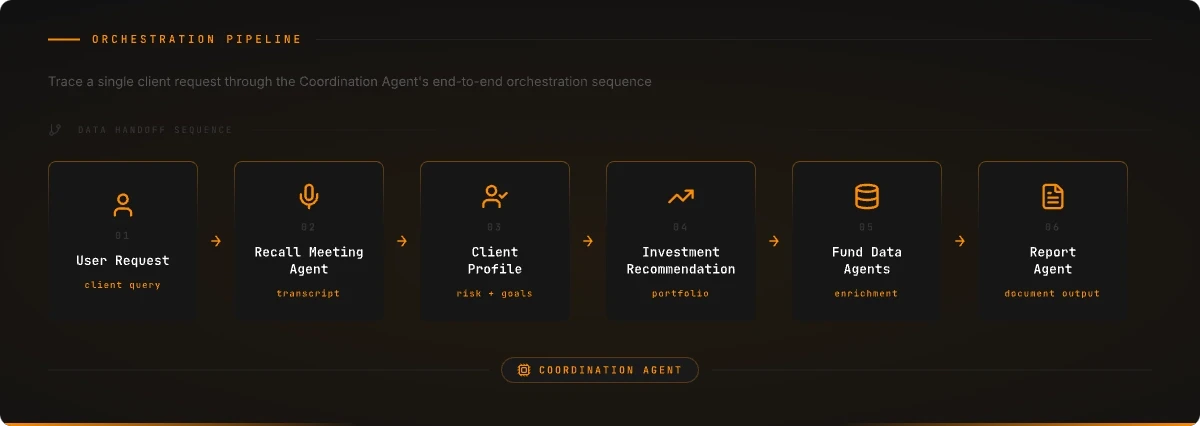
The Coordination Agent conducts the end-to-end workflow: receiving user requests, delegating transcript extraction, passing client profiles to the recommendation engine, merging client and fund data, and handing combined outputs to the Report Agent. The Report Agent automates suitability report generation through template parsing, LLM-driven data extraction, and document population, producing compliance-ready Word documents with text fields, repeating fund tables, and inline performance charts.
CoralOS Coordination
All agents register with a Coral server and communicate through thread-based messaging with mention-based delegation. CoralOS extends the Model Context Protocol (MCP) with agent discovery, shared state, and trust primitives. Workflows are expressed as declarative graphs supporting parallel execution and graceful degradation, meaning a failure in one agent does not cascade through the system.
Business Impact Analysis
Labour Cost Displacement
The manual advisory workflow and its associated costs are well-documented across industry salary data. The impact varies by role, with higher-paid roles yielding greater per-client savings:
Role | Average Salary | Daily Rate | Manual Cost per Client (3-4 days) | CoralOS Review Cost (1-2 hours) |
|---|---|---|---|---|
Investment Analyst / PM | £61,000/year | ~£277/day | £830-£1,110 | ~£70 |
Financial Advisor | £50,000/year | ~£198/day | £595-£790 | ~£50 |
Paraplanner | £35,000/year | ~£139/day | £415-£555 | ~£35 |
Financial advisor salaries reflect a UK average of approximately £50,000 (Indeed, Glassdoor 2025-26 data), while paraplanner salaries average approximately £35,000 (Indeed, Glassdoor, PayScale 2025-26 data). Both figures exclude London premiums, which typically run 17-24% higher.
The manual process covers client discovery (meeting transcription, data extraction), fund research across fragmented databases, portfolio construction with diversification analysis, and report compilation with regulatory compliance checks. Each stage introduces delay, inconsistency risk, and opportunity cost. Regardless of which role performs this work, CoralOS automates the entire chain. The human role shifts from performing the work to reviewing the output, a fundamentally different and more scalable activity.
Net Savings Per Client
Role | Manual Cost Displaced | Review Cost | System Cost (LLM tokens) | Net Saving per Client |
|---|---|---|---|---|
Investment Analyst / PM | £830-£1,110 | -£70 | -£0.04 to -£0.12 | ~£760-£1,040 |
Financial Advisor | £595-£790 | -£50 | -£0.04 to -£0.12 | ~£545-£740 |
Paraplanner | £415-£555 | -£35 | -£0.04 to -£0.12 | ~£380-£520 |
Even at the lowest-paid role in the advisory workflow, CoralOS delivers savings exceeding £380 per client. At the analyst/PM level, net savings approach or exceed £1,000 per client.
In firms where client workflows are distributed across a team (advisor handling client meetings, paraplanner conducting research and suitability analysis, analyst constructing portfolios), CoralOS displaces labour at each salary tier simultaneously. A team operating at blended rates across all three roles could see combined per-client savings in the range of £550-£750, depending on workload allocation, with additional savings from the elimination of inter-role coordination overhead that CoralOS handles natively through agent-to-agent delegation.
The system's LLM operating cost is derived from actual token consumption across all agents. Every agent in the system uses a consistent pricing model of $0.000001 per token, tracked in real-time through a ClaimHandler that communicates with the Coral server for budget enforcement. A typical end-to-end workflow, from meeting transcript processing through fund recommendation to final report generation, consumes 50,000-150,000 tokens total, costing $0.05-$0.15 per client.
Annual Impact at Scale
Clients per Year | Annual Labour Savings | System LLM Cost | Net Annual Savings |
|---|---|---|---|
50 | £38,000-£52,000 | ~£4-£6 | £38,000-£52,000 |
100 | £76,000-£104,000 | ~£8-£12 | £76,000-£104,000 |
250 | £190,000-£260,000 | ~£20-£30 | £190,000-£260,000 |
500 | £380,000-£520,000 | ~£40-£60 | £380,000-£520,000 |
At 250 clients annually, equivalent figures for financial advisor and paraplanner roles are £136k-£185k and £95k-£130k respectively. At every scale, the LLM operating cost is immaterial relative to labour savings. The system effectively pays for itself on the first client.
System Cost Breakdown by Agent
Token consumption varies by agent role. Agents with heavier LLM workloads (transcript analysis, report generation, orchestration) support up to 200,000 tokens per iteration, while data retrieval agents operate within 2,000-token limits:
Agent | Max Tokens per Iteration | Typical Role in Workflow |
|---|---|---|
Recall Meeting Agent | 200,000 | Transcript processing, client data extraction |
Coordination Agent | 200,000 | Workflow orchestration, data merging |
Report Agent | 200,000 | Template population, compliance document generation |
Investment Recommendation Agent | 20,000 | Portfolio construction, fund selection |
FE Analytics Data Agents (x4) | 2,000 each | Fund data retrieval, analytics queries |
Graph Agent | 2,000 | Chart and table generation |
Sanctions Data Agent | 2,000 | Compliance screening |
The three high-token agents (Recall Meeting, Coordination, Report) account for the majority of per-client LLM spend, but even at maximum output their combined cost would be $0.60 per iteration, well under $1.00 for a complete workflow.
Beyond Direct Labour Savings
The figures above capture only analyst time displacement. Additional business value includes:
Faster Time to Recommendation A process that previously took 3-4 days now completes in minutes of system execution plus 1-2 hours of review. Clients receive recommendations within the same day rather than waiting nearly a week. In competitive advisory contexts, speed directly impacts client conversion.
Consistency and Compliance Quality Manual report compilation introduces variability: different analysts structure reports differently, miss disclosure requirements, or make data transcription errors. CoralOS produces structurally identical, template-driven outputs every time. Every suitability report follows the same FCA/MiFID II-compliant structure with consistent disclosures, fund detail formatting, and risk profiling.
Scalability Without Proportional Headcount The traditional model creates a linear relationship between client volume and analyst headcount. A senior analyst becomes a bottleneck, limiting the number of clients a firm can profitably serve. CoralOS breaks this constraint: the same analyst can review 5-10 system-generated reports in the time previously spent producing one manually, making the mass-affluent market segment economically viable.
Full Audit Trail Coral Protocol's trust and accountability primitives mean every agent action is logged and attributable. Every piece of work, from transcript extraction to fund selection to report generation, carries a built-in audit trail. This is a meaningful compliance advantage in regulated financial services where demonstrating the basis for recommendations is a regulatory requirement.
Reduced Context Switching Advisors currently navigate between meeting notes, multiple fund research platforms (FE Analytics, Morningstar), compliance checklists, and report templates. CoralOS consolidates these into a single workflow. The cognitive load reduction, while difficult to quantify, contributes to both output quality and advisor satisfaction.
Summary

CoralOS delivers a clear, quantifiable return: £760-£1,040 saved per client against a system operating cost of £0.04-£0.12 per client. At 250 clients annually, this translates to approximately £190k-£260k in net savings, with the system's own cost totalling roughly £30 for the year.
The architectural choice of specialised, coordinated agents rather than a monolithic system provides resilience (individual agent failures do not cascade), extensibility (new agents can be added without rearchitecting), and cost efficiency (lightweight data agents operate at fraction-of-a-penny token budgets). For financial advisory firms, the business case is unambiguous: CoralOS replaces days of manual work with minutes of automated execution, at negligible marginal cost, while improving the consistency and compliance quality of every output.